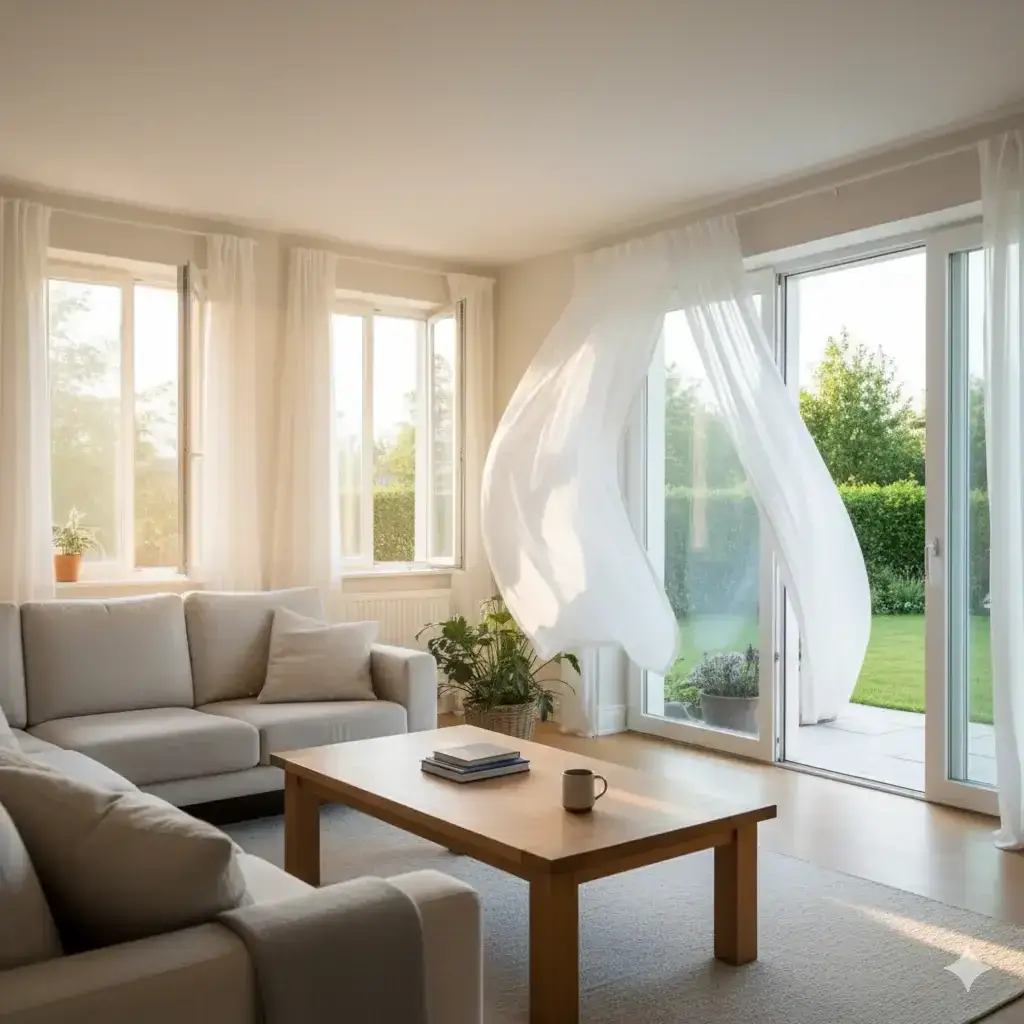
Indoor air quality deteriorates rapidly in sealed heated spaces as CO₂ accumulates above cognitive impairment thresholds, humidity promotes mould growth, and VOCs concentrate. The Stosslüften technique — brief 5–10 minute bursts of fully open windows — provides complete air exchange while minimising heat loss, costing only 3–5% additional heating energy compared to 15–30% for continuously cracked windows.
When temperatures drop and the instinct is to seal every crack and crevice against the cold, you face one of the fundamental tensions of indoor living in winter: the need for warmth versus the need for air. A tightly sealed, well-heated room is comfortable — for about an hour. After that, carbon dioxide accumulates from breathing, humidity rises from perspiration and cooking, volatile organic compounds off-gas from furniture and cleaning products, and the oxygen content begins to decline imperceptibly. The room that felt warm and welcoming becomes stuffy, headache-inducing, and paradoxically unhealthy. Proper ventilation in cold weather is not an optional refinement of indoor comfort; it is a health necessity that, when neglected, produces consequences ranging from chronic fatigue and respiratory illness to structural damage that can cost thousands to repair.
TL;DR: Indoor air quality deteriorates rapidly in sealed, heated spaces during cold weather. CO₂ levels rise above recommended thresholds (1,000 ppm) within 1–2 hours in an unventilated occupied room. Humidity from breathing, cooking, and bathing promotes condensation and mould growth. Volatile organic compounds from furniture, paint, and cleaning products accumulate to levels that cause headaches and respiratory irritation. The solution is controlled ventilation: brief, intense airing (5–10 minutes of wide-open windows, 2–3 times daily) rather than continuously cracked windows, which waste heat without providing adequate air exchange. Mechanical ventilation with heat recovery (MVHR) systems provide the optimal solution for new and renovated buildings.
1,000 ppmCO₂ threshold above which concentration and alertness decline
5–10 minOptimal window-opening duration for cold weather ventilation
10–15 LMoisture produced daily by a family of four through breathing and activities
40–60%Optimal indoor humidity range for health and building protection
The Indoor Air Problem: What Builds Up When You Seal Up
A human being at rest exhales approximately 200 millilitres of carbon dioxide per minute. In a typical bedroom occupied by two people with windows closed and no mechanical ventilation, CO₂ concentration rises from the outdoor baseline of approximately 420 ppm to over 1,000 ppm within 60–90 minutes, and can exceed 2,500 ppm by morning. Research has consistently demonstrated that CO₂ levels above 1,000 ppm impair cognitive function, reduce concentration, and increase drowsiness — effects that most people attribute to poor sleep rather than poor air. At 2,500 ppm and above, headaches, lethargy, and a generalised sense of malaise become common. The "morning fog" that many people experience is, in many cases, a CO₂ hangover from sleeping in a sealed room.
Humidity is the second critical accumulation. Each person generates approximately 40–70 grams of water vapour per hour through breathing and perspiration, rising to several hundred grams during cooking, showering, or drying laundry indoors. In a sealed home, this moisture has nowhere to go. It raises indoor humidity above 60 percent (the threshold for mould growth), condenses on cold surfaces (windows, external walls, behind furniture), and creates the persistent dampness that feeds mould, dust mites, and bacterial growth. In Greece's traditional stone houses, where wall surface temperatures in winter can fall well below the dew point of the indoor air, condensation and mould are endemic winter problems that ventilation directly addresses.
Volatile organic compounds (VOCs) — chemicals released by furniture, carpets, paint, cleaning products, and building materials — constitute a third category of indoor air contaminant that accumulates in sealed spaces. New furniture and recently renovated rooms emit the highest VOC levels, but even established interiors produce a background VOC load that ventilation must remove. Formaldehyde, benzene, toluene, and other VOCs are associated with respiratory irritation, headache, and in chronic high-concentration exposure, more serious health effects. The "new car smell" or "fresh paint smell" that many people find pleasant is, chemically, the smell of volatile organic compounds at concentrations above the threshold for sensory detection — and often above the threshold for health effects.
The Stosslüften Technique: German Engineering Applied to Air
The German word Stosslüften — literally "shock ventilation" or "burst ventilation" — describes the most energy-efficient and air-quality-effective method of ventilating a heated space in cold weather. The technique is simple: open all windows in the room fully (not cracked — fully open) for 5–10 minutes, creating a complete air exchange, then close all windows and allow the room to reheat. This brief, intense ventilation replaces the entire volume of stale indoor air with fresh outdoor air while minimising heat loss from the thermal mass of the room — the walls, floor, ceiling, and furniture, which retain their heat during the short ventilation period.
The physics explains why Stosslüften is superior to the common practice of leaving a window cracked. A slightly open window provides a slow, continuous trickle of cold air that cools the room's surfaces (thermal mass) over hours, requiring significant energy to reheat them. Meanwhile, the air exchange rate is often insufficient to meaningfully reduce CO₂ or humidity levels. A fully open window for five minutes provides rapid, complete air exchange — replacing the entire room volume — while the thermal mass retains most of its stored heat, so the room returns to comfortable temperature within minutes of closing the windows. The energy cost of one Stosslüften event is a fraction of the energy lost through hours of cracked windows.
The technique should be applied 2–3 times daily in occupied rooms, and immediately after moisture-generating activities (cooking, showering, drying laundry). Cross-ventilation — opening windows on opposite sides of the building simultaneously — is the most effective variant, as it creates a through-draft that exchanges air faster than single-sided ventilation. In Greek apartments, where most units have windows on only one exterior facade, opening the front door briefly during ventilation creates the cross-draft that single-facade geometry otherwise prevents. The entire process takes less than ten minutes and has a disproportionately large effect on indoor air quality.
Moisture Management: The Mould Prevention Priority
In the hierarchy of ventilation objectives, moisture control is the most immediately consequential because the failure mode — mould growth — produces visible, damaging, and health-affecting results within days to weeks of sustained elevated humidity. A family of four produces approximately 10–15 litres of water vapour per day through breathing, cooking, bathing, and laundry. In a well-ventilated home, this moisture is carried outdoors by air exchange. In a sealed home, it accumulates, raises humidity, and inevitably finds cold surfaces on which to condense.
Cold bridges — structural elements that conduct heat from inside to outside more efficiently than the surrounding wall — are the primary condensation sites. In Greek buildings, these include concrete columns and beams (which have lower thermal resistance than the infill masonry), window frames (particularly the aluminium frames common in Greek construction), and the junctions between walls and ceilings. These cold bridges have surface temperatures several degrees below the surrounding wall, and when warm, moist indoor air contacts them, water vapour condenses — creating the localised damp patches where mould first appears.
The practical solutions combine ventilation with targeted moisture management. Bathroom exhaust fans should run during and for 15 minutes after showering. Kitchen range hoods should be used whenever cooking with water (boiling, steaming). Laundry should be dried outdoors or in a well-ventilated space — never draped over radiators in sealed rooms, where the evaporated water has nowhere to go but into the building fabric. Furniture should be positioned at least 5 centimetres from external walls to allow air circulation that prevents stagnant pockets of humid air from forming against cold wall surfaces.
Mechanical Ventilation: The Modern Solution
For new construction and major renovation, mechanical ventilation with heat recovery (MVHR) systems represent the optimal solution to the cold-weather ventilation dilemma. These systems extract stale air from kitchens and bathrooms, pass it through a heat exchanger where it warms the incoming fresh air to within 5–10°C of indoor temperature, and distribute the pre-warmed fresh air to living spaces and bedrooms. The result is continuous ventilation without the heat loss associated with window-based methods — recovery efficiencies of 85–95 percent are standard in modern MVHR units.
The adoption of MVHR in Greek construction is growing but remains limited compared to northern European countries, where building regulations have required mechanical ventilation in new buildings for decades. The Mediterranean building tradition — with its emphasis on natural ventilation through operable windows, shutters, and transoms — has created a cultural expectation that fresh air comes from open windows, not from machines. This expectation is appropriate in the mild seasons when windows can remain open, but it creates a ventilation deficit in winter when the cold motivates window closure and the very conditions that demand fresh air also discourage its admission.
For existing buildings where MVHR installation is impractical, simpler mechanical solutions can significantly improve winter air quality. Trickle vents — small, adjustable openings installed in window frames — provide continuous low-level ventilation that maintains air freshness without significant draft or heat loss. Humidity-controlled extractor fans in bathrooms and kitchens activate automatically when moisture levels rise, removing the peak humidity loads that cause condensation. Even a basic timer-controlled exhaust fan in the bathroom, running for 30 minutes after each shower, prevents the most damaging humidity spikes that lead to mould growth.
Special Considerations: Bedrooms, Kitchens, and Bathrooms
Each room in a home has distinct ventilation requirements driven by its function and occupancy pattern. Bedrooms present the most overlooked ventilation challenge: occupied for 7–9 hours continuously with doors typically closed, they accumulate CO₂ to levels that measurably impair sleep quality. Studies published in Indoor Air found that sleepers in well-ventilated bedrooms (CO₂ below 800 ppm) reported better sleep quality, felt more refreshed upon waking, and performed better on next-day cognitive tests than sleepers in poorly ventilated rooms (CO₂ above 2,400 ppm). The simplest bedroom ventilation strategy is to leave the door open or crack the window — even a narrow gap provides sufficient air exchange for one or two sleepers.
Kitchens and bathrooms are the primary moisture generators in any home and require targeted extraction rather than general ventilation. A single shower produces 1–2 litres of water vapour; boiling a pot of pasta releases another litre. Without extraction, this moisture raises room humidity to 80–90 percent — levels that cause immediate condensation on cold surfaces and promote mould growth within days. Range hoods and bathroom extractor fans are not optional accessories in these rooms; they are essential moisture management tools. In Greece, where many older apartments lack built-in extraction, aftermarket fans installed in exterior walls or windows provide an affordable retrofit that prevents the majority of winter mould problems.
Energy Versus Health: The Real Cost Calculation
The resistance to cold-weather ventilation is primarily economic: opening windows wastes heat, and heat costs money. In Greece, where heating costs consume a significant portion of household budgets (particularly since the energy price increases of 2022–2023), the reluctance to "throw heat out the window" is understandable. But the cost calculation changes when the consequences of non-ventilation are included. Mould remediation in a seriously affected room costs several hundred to several thousand euros. Respiratory illness caused by poor indoor air quality produces medical costs, lost productivity, and reduced quality of life that far exceed the energy cost of adequate ventilation.
The energy cost of proper Stosslüften ventilation is measurably small. A study by the German Energy Agency (dena) calculated that three daily five-minute ventilation events in a typical heated room increased annual heating costs by approximately 3–5 percent — a modest addition that most households can absorb without difficulty. The same study found that the alternative — continuously cracked windows — increased heating costs by 15–30 percent while providing worse air quality. The burst ventilation method is both cheaper and more effective than the intuitive but physically inferior approach that most people default to.
The health cost of inadequate ventilation is harder to quantify but potentially larger. Chronic exposure to elevated CO₂ reduces cognitive performance by measurable amounts — a Harvard study found that cognitive function scores were 61 percent higher in well-ventilated offices (CO₂ below 600 ppm) than in conventionally ventilated ones (CO₂ above 1,000 ppm). For students studying in sealed rooms, professionals working from home in unventilated spaces, and the elderly spending long hours indoors in winter, this cognitive impairment represents a real if invisible cost. The room may feel warm, but the brain is not performing at its best — and the occupant, impaired by the very conditions they are experiencing, may not recognise the deficit.
The Stosslüften technique — opening windows fully for 5–10 minutes rather than leaving them cracked — provides complete air exchange while minimising heat loss from the room's thermal mass.
Key insight: The sealed, warm room is not the healthy room. It is a room in which CO₂ is rising, humidity is accumulating, volatile organic compounds are concentrating, and the occupant's cognitive function is declining — all invisibly, all gradually, and all reversibly with five minutes of open windows. The resistance to cold-weather ventilation is based on a false economy: the energy saved by not ventilating is dwarfed by the costs — in health, in building maintenance, and in cognitive performance — that inadequate ventilation produces.
The insulation paradox: Modern energy-efficient buildings are so well sealed that they require mechanical ventilation to remain habitable. The same airtightness that reduces heating costs to a fraction of their traditional-building equivalents also eliminates the natural air infiltration that older buildings provided unintentionally. A perfectly insulated building with no ventilation system is a perfectly sealed container for CO₂, humidity, and pollutants. Energy efficiency and air quality are not opponents — they are partners that must be designed together — but when insulation outpaces ventilation, the cure for one problem becomes the cause of another.
Cold weather ventilation essentials:
Open windows fully for 5–10 minutes, 2–3 times daily — this is more effective and more energy-efficient than leaving windows cracked
Cross-ventilate by opening windows on opposite sides of the building simultaneously for maximum air exchange
Always ventilate immediately after cooking, showering, or drying laundry to remove peak moisture loads
Keep furniture at least 5 cm from external walls to prevent condensation and mould in stagnant air pockets
Use bathroom exhaust fans during and for 15 minutes after showering — this single measure prevents most bathroom mould
If you wake with headaches or feel groggy in the morning, CO₂ accumulation in a sealed bedroom is a likely cause — crack the window or leave the bedroom door open overnight
In summary: Cold weather ventilation is not a luxury — it is a health necessity that protects occupants from CO₂ accumulation, humidity-driven mould growth, and VOC concentration, while preserving the building fabric from condensation damage. The Stosslüften technique — brief, intense ventilation through fully opened windows — provides complete air exchange at a fraction of the energy cost of continuously cracked windows. The investment in comfort, health, and building protection is repaid many times over. In Greece, where traditional building practices and Mediterranean climate habits can create winter ventilation deficits, adopting systematic ventilation practices transforms sealed winter interiors from stuffy containers into spaces that are both warm and genuinely healthy to occupy.