Istanbul for First-Timers: Essential Tips & Mistakes to Avoid
Essential advice for first-time visitors to Istanbul covering the most common mistakes tourists make and how to avoid them. Includes practical tips on currency exchange, transport navigation, restaurant selection, bazaar bargaining, mosque visit etiquette, neighbourhood safety, over-tourism hotspots, and the cultural norms that can trip up visitors unfamiliar with Turkish customs. Designed to help first-timers have a smoother, more authentic experience.
Istanbul will overwhelm you — and that is exactly why it rewards so richly. A city of 16 million people straddling two continents, Istanbul operates on a scale and at a pace that disorients first-time visitors who arrive expecting a Mediterranean holiday town. The Grand Bazaar alone has 4,000 shops across 61 covered streets. The Bosphorus separates Europe from Asia across a strait that carries 48,000 vessels per year. Traffic congestion ranks among the world's worst, the cuisine ranges from street-cart simit to Michelin-worthy rooftop restaurants, and the historical layers — Roman, Byzantine, Ottoman, Republican — compete for attention at every corner. First-timers who prepare for this complexity have an extraordinary time. Those who don't spend their visit confused, overcharged, and exhausted. This guide exists to put you in the first category.
TL;DR: Istanbul is a massive, two-continent city requiring preparation. Essential first moves: buy an Istanbulkart immediately (works on all transport, saves 50%), stay in Beyoğlu or Karaköy (not just Sultanahmet), use ferries for Bosphorus crossings (€0.40, 20 min), visit the Asian side (Kadıköy is unmissable). Common mistakes: taxi-only transport, ignoring the Asian side, wrong shoes for cobblestones and hills, visiting only Sultanahmet. Best months: April-June and September-October.
16M
Population across two continents — Europe's largest city
8,000+
Years of continuous human settlement
€0.40
Cost of a Bosphorus ferry crossing with Istanbulkart
3
UNESCO World Heritage zones within the city
Mistake #1: Staying Only in Sultanahmet
Beyond Sultanahmet — İstiklal Avenue and Beyoğlu reveal Istanbul's modern creative energy
Most first-timers book accommodation in Sultanahmet — the historic peninsula containing Hagia Sophia, the Blue Mosque, Topkapı Palace, and the Grand Bazaar — because it looks like "the center" on a map. Sultanahmet is indeed where the monuments concentrate, but it is not where Istanbul lives. The neighborhood empties after dark, restaurants cater to tourists at tourist prices, and the atmosphere is more museum district than vibrant city. After seeing the major sites (which takes 2-3 full days), you'll find yourself stranded in an area with limited nightlife, mediocre food, and poor transport connections.
Better base options: Beyoğlu (centered on İstiklal Avenue) offers nightlife, galleries, restaurants, and the feeling of a living neighborhood. Karaköy is a revitalized waterfront district with specialty coffee, design hotels, and walking distance to both Sultanahmet and the Galata Bridge. Kadıköy, on the Asian side, provides the most authentic local experience — incredible food markets, zero tourist infrastructure, and a 20-minute ferry ride to the European sights. Any of these neighborhoods gives you a base from which Istanbul's complexity becomes accessible rather than overwhelming.
Mistake #2: Taking Taxis Everywhere
Istanbul taxis are cheap by European standards but slow by any standard. The city routinely ranks in the top 5 globally for traffic congestion, and a taxi from Sultanahmet to Taksim that takes 15 minutes at midnight can take 90 minutes during rush hour — at a meter that keeps ticking. The solution is Istanbul's excellent public transport network: the T1 tram connects most tourist sites on the European side, the metro reaches the business districts, and the Marmaray tunnel provides rail connection under the Bosphorus to the Asian side. But the real revelation is the ferry system — Bosphorus ferries are fast, scenic, traffic-free, and cost approximately €0.40 with an Istanbulkart. The Eminönü-Kadıköy ferry at sunset is worth the trip to Istanbul alone.
Your first purchase should be an Istanbulkart — a rechargeable contactless card available at metro stations and kiosks. It works on every public transport mode (metro, tram, bus, ferry, funicular) and provides a roughly 50% discount over cash fares. Multiple people can use one card. Without it, you'll overpay for every journey and waste time buying individual tickets.
Navigating the Grand Bazaar and Shopping
The Grand Bazaar — 4,000 shops under one roof, navigated best with a plan and a budget
The Grand Bazaar is Istanbul's most famous shopping destination and also its most disorienting. With 4,000 shops across 61 covered streets, the bazaar operates on rules that reward preparation and punish spontaneity. The exterior streets and main arteries cater to tourists — this is where you'll find mass-produced ceramics, cheap leather goods, and aggressive shopkeepers. The interesting shops are deeper inside, in the specialized sections: the gold district (where prices track the global gold rate and are relatively fixed), the antique section (genuine finds exist but require knowledge), the textile alleys (where handwoven kilims and silk scarves justify their prices), and the tiny workshops where craftspeople still produce by hand.
Bargaining is expected but widely misunderstood. The opening price at a tourist-facing shop is typically 3-4 times the expected selling price — this is the game, and both sides know it. A reasonable target is 40-60% of the first quoted price, though this varies by product category. Leather and clothing have the highest markup; gold and silver the lowest (metal prices constrain the starting point). The most important rule is not about price — it's about enjoyment. Bazaar merchants are often excellent conversationalists, and the tea they offer is genuine hospitality, not just a sales tactic. The worst shopping experience in the Grand Bazaar comes from rushing through and feeling pressured. The best comes from sitting down, accepting the tea, and treating the negotiation as social interaction rather than commercial transaction. For fixed-price shopping without negotiation, the Arasta Bazaar (behind the Blue Mosque) offers quality crafts at marked prices, and the boutiques of Karaköy and Galata sell contemporary Turkish design at retail prices.
Mistake #3: Wrong Timing and Wrong Shoes
Istanbul's climate is more extreme than most visitors expect. July and August bring temperatures of 33-38°C with humidity that makes the city oppressive — queuing for Hagia Sophia in August heat is genuinely unpleasant. December through February drops to 3-8°C with rain, wind, and occasional snow. The optimal windows are April-June and September-October: comfortable temperatures (15-25°C), manageable crowds, and the outdoor café culture at its best.
Shoes matter more in Istanbul than in most cities. The historic peninsula is built on seven hills, the streets of Beyoğlu and Karaköy are steep and often cobblestoned, and the Grand Bazaar's marble floors are polished slippery by millions of feet. Bring comfortable, grippy walking shoes — not sandals, not dress shoes, not new shoes. You will walk 15-20 kilometers per day in Istanbul without trying, much of it uphill. Blisters on day one ruin an entire trip.
Weather and Seasonal Planning
Istanbul's weather varies more dramatically than its reputation as a "Mediterranean city" suggests. The city sits at the collision point between Black Sea moisture and continental air from Anatolia, producing weather patterns that can shift rapidly within a single day. Spring (April-May) is the most photogenic season — wisteria and tulips bloom across the historic districts, temperatures hover at a comfortable 15-22°C, and the light over the Bosphorus has a clarity that summer haze obscures. But spring weather is unstable: a warm, sunny morning can become a cold, rainy afternoon within hours, and a light jacket and compact umbrella are essential even on days that begin cloudless.
Autumn (September-October) offers the most reliable weather for sightseeing: stable warm days (20-28°C), low rainfall, and the summer tourist crowds thinning noticeably after mid-September. November marks a sharp transition — temperatures drop, rain becomes frequent, and the Bosphorus winds pick up to levels that make ferry crossings bracing rather than pleasant. Winter visitors should not underestimate Istanbul's cold: the poyraz (northeast wind from the Black Sea) drives damp cold through the city's exposed streets, and the combination of 3-5°C temperatures, 80% humidity, and persistent wind creates a penetrating chill that the city's architecture — designed for ventilation rather than insulation — does nothing to mitigate. Snow falls 2-4 times per winter on average, occasionally heavily enough to disrupt transport and close the Bosphorus to shipping. Mosque interiors, museum visits, and the covered Grand Bazaar become weather-resistant activity anchors during winter visits, while the steam rooms of historic hamams (Turkish baths) offer warmth that is both physical and cultural.
The Asian Side Is Not Optional: First-timers often treat the Asian side of Istanbul as an afterthought — if they visit at all. This is the biggest mistake you can make. Kadıköy is where Istanbulites go to eat: its food market (Kadıköy Çarşısı) is superior to anything on the European side, its restaurants serve locals rather than tourists, and its waterfront bars offer Bosphorus views without Bosphorus prices. Moda, the residential neighborhood adjacent to Kadıköy, has a seaside promenade, independent boutiques, and an atmosphere that captures modern Istanbul better than any monument. Take the ferry from Eminönü — the 20-minute crossing is itself a highlight — and spend at least a half-day exploring.
Food: What to Eat and Where
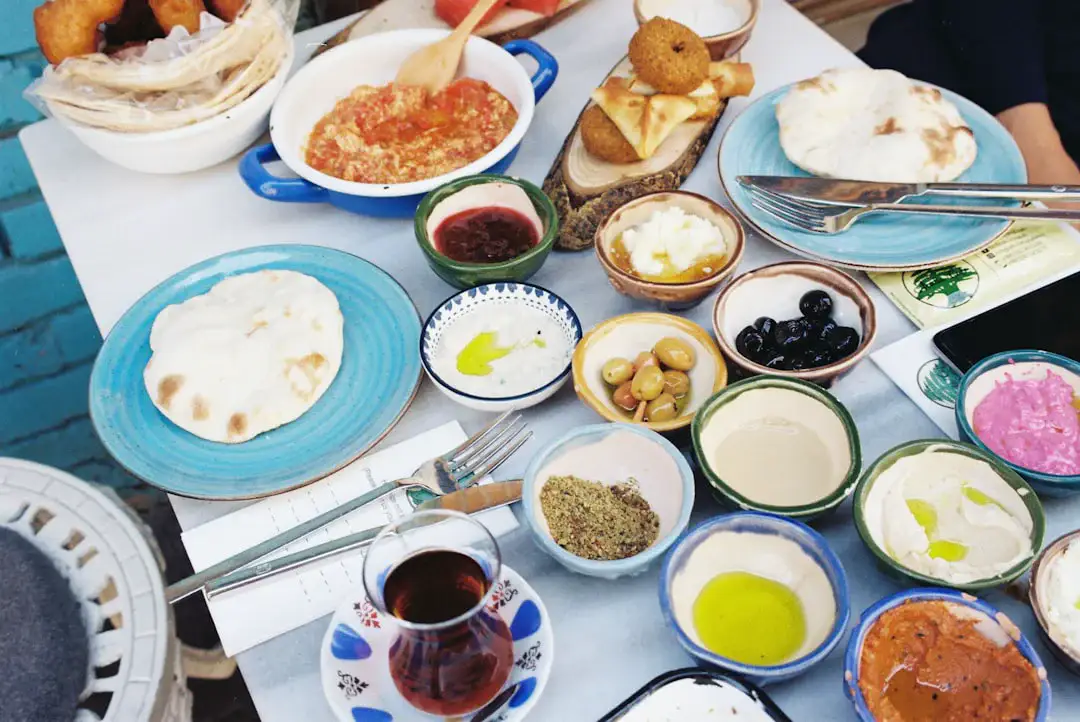
Turkish breakfast — a lavish spread of cheese, olives, eggs, and fresh bread that defines Istanbul mornings
Istanbul's food scene is vast and stratified. Tourist-area restaurants near Sultanahmet and along İstiklal Avenue serve adequate but unremarkable food at inflated prices. The real eating happens in neighborhoods: Kadıköy's market for breakfast (simit, börek, fresh cheese, olives), Karaköy for fish sandwiches at the Galata Bridge, Beyoğlu's back streets for meyhane (Turkish tavern) dinners with meze and rakı, and anywhere locals are queuing for street food. Turkish breakfast (kahvaltı) is an event — not a meal — featuring 15-20 small plates of cheese, honey, olives, eggs, tomatoes, and fresh bread. Order it at least once at a proper breakfast restaurant.
Street food in Istanbul deserves its own itinerary. The simit (sesame-crusted bread ring) sold from glass carts on every corner costs ₺5-10 and is the city's most ubiquitous snack. Balık ekmek (fish sandwich) at the Galata Bridge — grilled mackerel in bread with onions and lettuce — is a ₺40-60 lunch that connects you to a tradition centuries old. Lahmacun (thin-crust minced meat flatbread), döner (not the European imitation but the real thing, sliced from a vertical spit), and midye dolma (stuffed mussels sold by street vendors in İstiklal and the fish market) offer flavors that restaurant menus cannot replicate because the context — standing on a noisy street, sharing space with locals, eating with your hands — is part of the experience. For a sit-down meal that captures Istanbul's culinary range, find a meyhane in Beyoğlu: order an array of cold meze (starters), a grilled fish main, and a bottle of rakı (anise spirit mixed with water), and you will understand why Istanbulites consider this the city's true cuisine — not the elaborate Ottoman dishes of tourist restaurants, but the communal, convivial, slow-paced meal that unfolds over hours.
Tourist Trap Paradox: Istanbul's most famous tourist experiences — the Grand Bazaar, the Spice Market, rooftop restaurant dinners — are simultaneously real and performed. The Grand Bazaar is a genuine 560-year-old marketplace, but the "special price just for you" negotiation is theater performed for tourist expectations. The Spice Market sells real spices, but the ones displayed at the entrance are priced for cruise ship passengers, not locals. The rooftop restaurants serve real Turkish food, but at prices that would make any Istanbulite laugh. None of this means you should skip these experiences — but approach them as entertainment rather than authentic shopping, and do your real eating and buying in the neighborhoods where locals actually live.
Buy an Istanbulkart on arrival — it works on all transport and saves 50% on fares
Base yourself in Beyoğlu, Karaköy, or Kadıköy rather than Sultanahmet for a more authentic experience
Take the Eminönü-Kadıköy ferry at sunset — it's the best €0.40 you'll spend in Istanbul
Bring comfortable walking shoes with grip — Istanbul is hilly, cobblestoned, and you'll walk 15-20 km per day
Istanbul does not simplify itself for visitors — and that is precisely its appeal. The city that has been a capital of three empires across 1,600 years does not arrange itself into neat tourist zones with clear signage and convenient schedules. It sprawls across two continents, speaks a language most visitors do not understand, and operates on rhythms that take days to internalize. But the first-timer who arrives prepared — Istanbulkart in pocket, comfortable shoes on feet, ferry schedule bookmarked, Asian side on the itinerary — discovers a city where the overwhelming complexity becomes the point rather than the obstacle. Istanbul rewards preparation not with efficiency but with access: access to neighborhoods, experiences, food, and perspectives that the unprepared visitor never finds. The city does not meet you halfway. But if you go to it on its terms, it gives back more than almost any city on Earth.