How to Get Around London: Complete Transport Guide
How to navigate London using the extensive Underground, bus, Overground, DLR, and river bus networks. Covers the Oyster Card and contactless payment systems, zone-based fares, the best transport apps, when to walk versus ride, airport transfers from Heathrow, Gatwick, Stansted, and Luton, and the insider tips that help visitors move efficiently through one of the world's most complex but well-connected urban transport systems.
London's transport network is one of the most complex, extensive, and efficient public transit systems in the world — and also one of the most confusing for visitors encountering it for the first time. The Underground alone has 272 stations across 11 lines, serving 5 million journeys per day. Add the Overground, the Elizabeth line, the DLR, the bus network (9,000 buses on 675 routes), the river bus services, the national rail connections, and the cycling infrastructure, and you have a system capable of getting you anywhere in Greater London — if you understand how the pieces connect. This guide cuts through the complexity to give you the practical knowledge that transforms London's transport from overwhelming to effortless: which card to buy, which lines to take, how the zones work, when to ride and when to walk, and the money-saving tricks that regular Londoners use every day.
TL;DR: Use a contactless bank card or Oyster card — never buy paper tickets (they cost 2-3x more). London is divided into 9 fare zones — most tourist attractions are in Zones 1-2 (£2.80 per journey off-peak). Daily caps limit spending automatically (£8.10 for Zones 1-2). The Tube is fastest for cross-city journeys but buses (£1.75 flat fare, capped at £5.25/day) are better for short hops and seeing the city. The Elizabeth line connects Heathrow to central London in 30 minutes for the standard fare (no £25 Heathrow Express needed). Walk more than you think — many "nearby" Tube stations are actually 5-minute walks apart above ground.
272
Underground stations across 11 lines — the world's oldest metro
£8.10
Daily spend cap for Zones 1-2 with contactless or Oyster
675
Bus routes covering every corner of Greater London
30 min
Heathrow to central London via Elizabeth line — at standard Tube fare
Payment: Contactless Is King
The single most important transport advice for London visitors: use a contactless payment card (Visa, Mastercard, or Amex debit/credit card) or an Oyster card. Never buy paper tickets. A single Zone 1 journey costs £6.70 on a paper ticket versus £2.80 with contactless or Oyster — more than double for the identical journey. The contactless system automatically applies daily and weekly caps, meaning you never pay more than the equivalent of a Travelcard regardless of how many journeys you make. The daily cap for Zones 1-2 is £8.10, which means your fourth or fifth journey of the day is essentially free.
Contactless bank cards have a significant advantage over Oyster for international visitors: no £7 deposit (refundable but inconvenient), no need to top up, automatic currency conversion, and weekly capping (Monday to Sunday) that Oyster does not offer without purchasing a weekly Travelcard. If your bank card has contactless enabled (the wave symbol), it is your best London transport payment method. One caveat: use the same card for all journeys to ensure capping works — if you tap in with one card and tap out with another, you will be charged maximum fare on both.
The Underground: When to Use It (and When Not To)
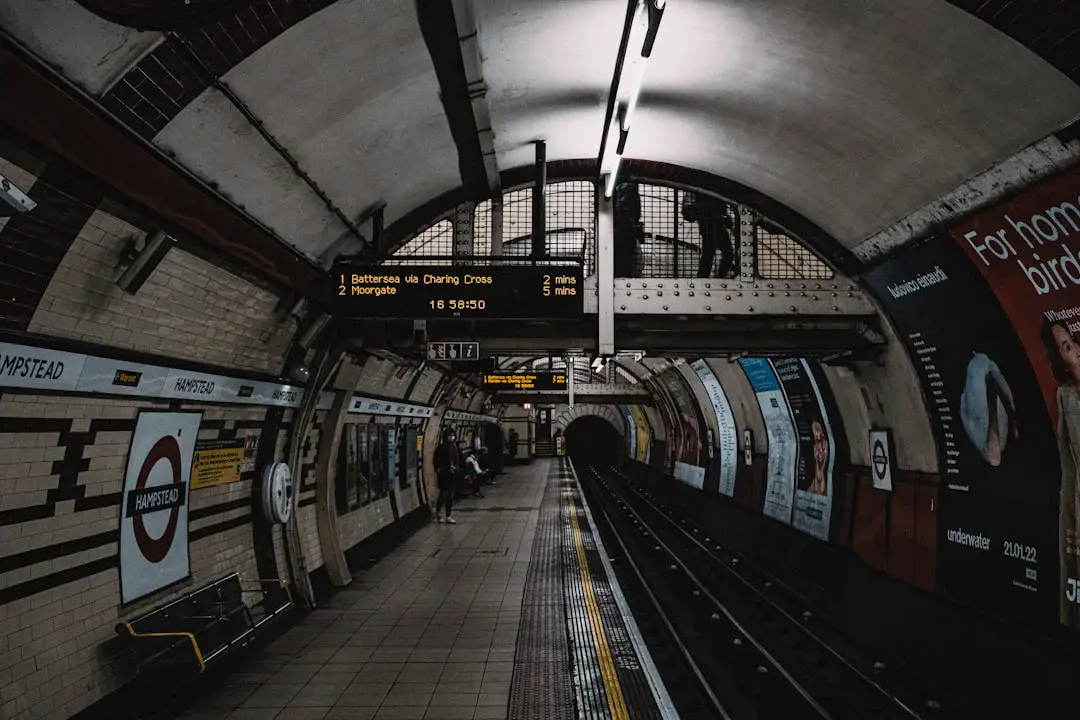
The London Underground — 272 stations connecting every corner
The Tube is London's backbone, but it is not always the best option. It excels at cross-city journeys of 3+ kilometers where surface traffic would be slow: Paddington to King's Cross, Westminster to Canary Wharf, Heathrow to central London. It is less useful for short hops between adjacent areas — the time spent descending to platforms, waiting, and ascending at the other end often exceeds the time it would take to walk or bus. Leicester Square to Covent Garden, one of the most used Tube journeys by tourists, takes 5 minutes on the Tube including walking time — but is a 3-minute walk above ground. Check distances before defaulting to the Underground.
Timing matters enormously. Rush hour (7:30-9:30 AM and 5:00-7:00 PM on weekdays) transforms the Tube from convenient to sardine-can. If possible, shift your schedule: museums and attractions are less crowded before 10 AM anyway, and traveling off-peak also saves money (off-peak fares apply after 9:30 AM on weekdays and all day on weekends). The Central, Northern, Victoria, and Jubilee lines are the most crowded; the District, Circle, Metropolitan, and Hammersmith lines are generally more manageable.
The Elizabeth Line and Airport Connections
Opened in 2022, the Elizabeth line (purple on the map) is London's newest and most transformative rail link. It connects Heathrow and Reading in the west to Shenfield and Abbey Wood in the east, passing through Paddington, Bond Street, Tottenham Court Road, Farringdon, Liverpool Street, and Canary Wharf — all in spacious, air-conditioned, step-free carriages that feel like a different century compared to the Victorian-era Tube. For visitors, the primary application is Heathrow: the Elizabeth line reaches Terminal 5 to Paddington in approximately 30 minutes for the standard contactless fare (£5.60 off-peak), compared to the £25 Heathrow Express or the £6 Piccadilly line that takes twice as long.
Other airport connections follow different logic. Gatwick is best reached via the Gatwick Express (£19.90, 30 minutes to Victoria) or Southern/Thameslink trains (£10-15, 35-45 minutes to various central stations). Stansted connects via the Stansted Express to Liverpool Street (£19.40, 47 minutes). Luton requires a train to Luton Airport Parkway plus a shuttle bus (total 45-60 minutes, £16-25). City Airport is the simplest: the DLR runs directly from the terminal to Bank station in Zone 1 for the standard contactless fare. For all airports, the key principle is identical: avoid the premium-branded express services when a standard rail connection on the same route costs 40-60% less with a marginally longer journey time.
Buses: London's Best-Kept Transport Secret
London buses — routes that double as sightseeing tours
London's iconic red buses are underused by tourists who default to the Tube for every journey. This is a mistake. Buses cost a flat £1.75 per journey (capped at £5.25/day) — cheaper than the Tube — and unlike the Underground, they let you see the city as you travel. Route 11 passes Westminster, Trafalgar Square, and St Paul's Cathedral. Route 15 runs from Tower Hill through the City. The RV1 connects Tower Bridge, Tate Modern, and the South Bank. These routes are de facto sightseeing tours at the price of a standard bus fare.
Buses also serve areas that the Tube does not — much of south London, residential neighborhoods, and the connections between adjacent areas that do not have convenient Tube links. The "hopper fare" allows unlimited bus transfers within 60 minutes for a single £1.75 fare, making multi-hop bus journeys remarkably cheap. The trade-off: buses are slower than the Tube in traffic and less predictable in timing, but for short journeys, sightseeing routes, and south London travel, they are the smarter choice.
Walking and Cycling: The Overlooked Options
Walking London — crossing the Thames on foot
London is a more walkable city than most visitors realize. The Tube map distorts distances — stations that appear far apart are often 10-15 minute walks on the surface. Walking from Covent Garden to the British Museum takes 10 minutes. Westminster to Buckingham Palace is 8 minutes. Tower Bridge to Borough Market is 12 minutes. Each of these walks passes through interesting streetscapes that the Tube removes from the experience. A good rule of thumb: if two locations are within 2 Tube stops on the same line, walk — you will save money, see more, and often arrive at the same time.
Santander Cycles ("Boris Bikes") provide an affordable cycling option: £1.65 for 30-minute rides, with docking stations every few hundred meters in central London. The growing network of cycle lanes (many physically separated from traffic) makes cycling increasingly safe. The riverside path along the South Bank from Westminster to Tower Bridge is one of London's finest cycling routes — flat, scenic, and traffic-free. Cycling is not for every visitor, but for the confident cyclist, it is the fastest and cheapest way to move through central London.
Weather and Transport Strategy
London's weather directly affects which transport modes are practical on any given day. Rain — which falls on approximately 150 days per year — makes walking and cycling less appealing and increases bus journey times as traffic slows. On rainy days, the Tube becomes the default for distance and buses for short hops with covered bus stops providing shelter. The Tube's underground nature makes it weather-proof but also means it offers no awareness of conditions above — check weather before descending, because emerging from an Underground station into unexpected rain without an umbrella is a quintessential London tourist experience.
Summer heat (25-35°C in July-August, rare but increasing) transforms the Tube from uncomfortable to genuinely oppressive. The deep-level lines — Central, Bakerley, Northern, Victoria — have no air conditioning and routinely exceed 35°C during summer heat waves, with temperatures occasionally reaching 40°C on platforms. The newer lines (Elizabeth, Jubilee, Metropolitan) are air-conditioned and far more comfortable. In summer heat, prefer surface transport (buses have air conditioning), walking in shade, or the newer Tube lines. Winter cold (0-5°C, November-March) makes walking distances feel longer and wind-exposed bus stops less pleasant — this is when the Tube earns its value despite crowding. The river bus services (Thames Clippers) operate year-round and provide a scenic, weather-dependent alternative: delightful in summer, bracing in winter, and a genuine transport option connecting Greenwich, Canary Wharf, the South Bank, and Westminster at Zones 1-2 contactless fares.
Key insight: London's transport network is designed for a city where weather is a daily variable — rain-proof Underground stations, covered bus stops, and a culture of carrying umbrellas reflect a climate where drizzle is the default and sunshine is the surprise. Understanding how weather affects each transport mode (rain slows buses, heat disrupts Tube services, fog delays flights, ice closes cycle lanes) allows visitors and residents to choose the right mode for the day's conditions rather than fighting against them.
The Tube Map Paradox: Harry Beck's 1931 Tube map is a masterpiece of design — so successful that it became the model for metro maps worldwide. But its genius is also its trap: by straightening lines and equalizing distances, it makes the network legible at the cost of geographic accuracy. Stations that appear adjacent on the map may be kilometers apart in reality — and stations that appear distant may be a short walk. Bank and Monument are "different stations" on the map but are connected underground. Covent Garden and Leicester Square are one Tube stop apart but are a 3-minute walk at street level. The map is essential for planning Tube journeys but misleading for understanding London's geography. Always cross-reference with a real map (Google Maps, Citymapper) before assuming the Tube is the best route between two points.
Use a contactless bank card for all journeys — it auto-caps at £8.10/day for Zones 1-2, cheaper than paper tickets
Take the Elizabeth line from Heathrow — 30 minutes, standard fare, better than the £25 Heathrow Express
Walk between stations that are 1-2 stops apart — you'll see more and arrive at roughly the same time
Buses are cheaper (£1.75 flat, £5.25/day cap) and let you see the city — use routes 11, 15, or RV1 for free sightseeing
London's transport system is not complicated — it is complex. The distinction matters: a complicated system is hard to use even when you understand it; a complex system has many parts but becomes intuitive once you grasp the underlying logic. London's logic is this: contactless payment handles the cost automatically, the Tube handles cross-city distance, buses handle short hops and seeing the city, the Elizabeth line handles Heathrow and east-west express travel, and walking handles everything that the Tube map makes look farther than it is. Master these five principles and London's 272 stations, 675 bus routes, and 9 million daily journeys collapse into a system you can navigate as confidently as any Londoner — without the Londoner's tendency to complain about it.