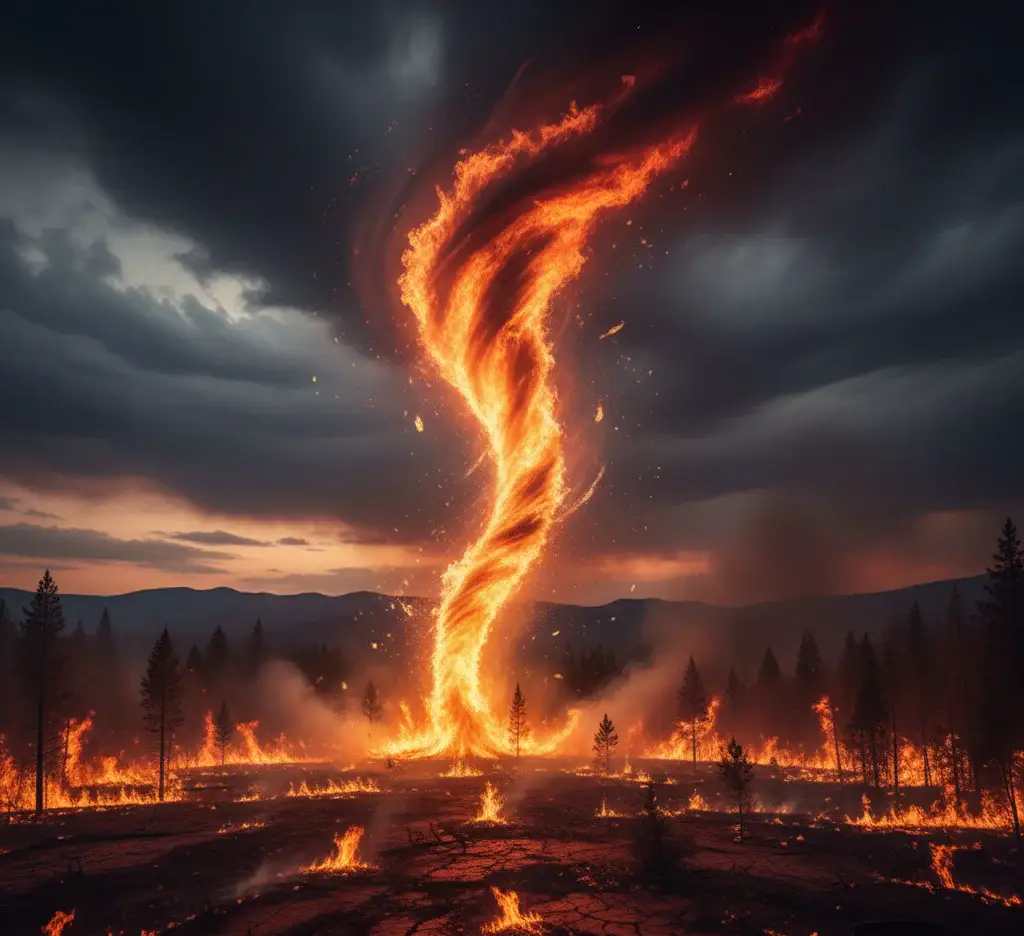
Firenadoes: When Extreme Heat Creates Vortexes of Flame
Fire whirls (firenadoes) are rotating columns of flame that form when intense wildfire heat creates powerful updrafts interacting with ambient wind shear. Ranging from small fire devils to massive vortices with 250+ km/h winds, fire whirls indicate a fire has crossed the threshold into generating its own weather. The deadliest killed 38,000 in Tokyo in 1923. Climate change is increasing their frequency through more intense wildfires.
When a wildfire burns hot enough and the atmospheric conditions align, something terrifying emerges from the flames: a rotating vortex of fire that rises from the burning ground like a tornado made of flame, reaching heights of tens to hundreds of metres and generating winds strong enough to uproot trees, hurl burning debris across firebreaks, and create new ignitions far ahead of the fire front. These are fire whirls — commonly called firenadoes, fire devils, or fire tornadoes — and they represent one of the most extreme and least predictable phenomena in fire behaviour, a convergence of combustion physics and atmospheric dynamics that transforms an already dangerous wildfire into something that resembles, and sometimes equals, the destructive power of a true tornado. Fire whirls have killed firefighters, destroyed structures that were outside the predicted fire path, and fundamentally altered the behaviour of wildfires by generating their own weather systems — making them one of the most feared phenomena in wildland firefighting.
TL;DR: Fire whirls (firenadoes) are rotating columns of fire that form when intense heat from a large fire creates a strong updraft that interacts with ambient wind shear or converging surface winds. The rising hot air begins to rotate (like water draining from a bathtub), concentrating angular momentum into a tight vortex that draws flames upward into a spinning column. Fire whirls range from small (1–3 m tall, lasting seconds) to extreme (hundreds of metres tall, lasting minutes to hours). The largest fire whirls can generate winds exceeding 250 km/h, loft burning debris kilometres ahead of the fire, and exhibit behaviour indistinguishable from a true tornado. They are most common during extreme wildfires in hot, dry, windy conditions.
250+ km/hWind speeds in the most extreme fire whirls — equivalent to an EF3 tornado
1,093°CCore temperature measured in large fire whirls — hot enough to melt aluminium
38,000+Deaths from the 1923 Tokyo firestorm fire whirl — deadliest in recorded history
100+ mHeight of large fire whirls — visible from kilometres away
Formation: How Fire Creates Its Own Tornado
Fire whirls form through the interaction of intense heat, ambient wind, and the rotation that develops when converging air currents meet a strong central updraft. The process begins with the fire itself: a large, intense fire heats the air above it rapidly, creating a powerful updraft — a column of rising hot air that can reach velocities of 20–50 m/s. This updraft draws in surrounding air at ground level to replace the air that is rising, creating converging surface winds that flow inward toward the base of the fire from all directions.
If the converging surface winds carry any angular momentum — any rotational component, however slight, from ambient wind shear, terrain channelling, or the interaction of multiple air currents — the updraft concentrates this rotation through the conservation of angular momentum, exactly as an ice skater spins faster by pulling in their arms. The converging air, rotating slowly at the periphery, spins faster and faster as it is drawn inward toward the updraft column, eventually forming a tight vortex that extends from the ground surface upward through the fire plume. When this vortex entrains flames, it becomes a fire whirl — a visible, spinning column of fire that is simultaneously a combustion phenomenon and an atmospheric vortex.
The crucial factor is the intensity of the fire. Small campfires and even moderate wildfires rarely produce fire whirls because their updrafts are too weak to concentrate angular momentum into a tight vortex. Large, intense fires — those burning through heavy fuel loads in hot, dry conditions — produce updrafts powerful enough to initiate the vortex formation process. The threshold is not precisely defined, but fire whirls become increasingly common as fire intensity exceeds approximately 10,000 kW per metre of fire front — intensities characteristic of crown fires in coniferous forests, fires in heavy brush or chaparral, and the massive wildfires that have become increasingly common in the era of climate change.
Types and Scale: From Dust Devils to Firestorms
Fire whirls span an enormous range of scale and intensity. At the small end, fire devils — miniature fire whirls a metre or two in diameter and a few metres tall — are common features of prescribed burns, agricultural burning, and moderate wildfires. These small whirls form frequently, last seconds to minutes, and pose little danger beyond the immediate vicinity of their base. They are the fire equivalent of dust devils: fascinating to watch but not significantly hazardous.
At the large end, fire whirls produced by extreme wildfires or urban firestorms can reach heights exceeding 100 metres, generate wind speeds above 250 km/h (equivalent to an EF3 tornado on the Enhanced Fujita scale), and persist for minutes to hours. These extreme fire whirls are functionally indistinguishable from true tornadoes in their wind speeds and destructive capability — the difference is that they are generated by fire-driven convection rather than thunderstorm dynamics. The 2018 Carr Fire in California produced a fire whirl that was officially classified as a fire tornado by the National Weather Service — the first such classification — with estimated wind speeds of 230 km/h and a path of destruction consistent with an EF3 tornado.
Between these extremes lies a continuum of fire whirl sizes and intensities that are a regular feature of large wildfires. Moderate fire whirls — 10–50 metres tall, with wind speeds of 50–100 km/h — occur frequently during the peak burning periods of major wildfires and pose significant hazards to firefighters by lofting burning debris across firebreaks, suddenly changing the direction and intensity of the fire, and creating localised wind conditions that can trap personnel who expected the fire to behave predictably. The unpredictability of fire whirl formation — which depends on the constantly shifting interaction of fire intensity, wind patterns, and terrain — makes them one of the most dangerous phenomena in wildland firefighting.
The Deadliest Fire Whirl: Tokyo, 1923
The most devastating fire whirl in recorded history occurred not in a wildfire but in the aftermath of the Great Kanto Earthquake of September 1, 1923. The magnitude 7.9 earthquake struck the Tokyo-Yokohama region at 11:58 AM, overturning cooking fires and igniting a conflagration that spread rapidly through the wooden buildings of Tokyo. As the fires merged and intensified throughout the afternoon, they generated their own wind systems — and in the Hifukusho-ato area of Tokyo, where approximately 38,000 people had gathered in an open area they believed would be safe from the flames, a massive fire whirl formed.
The fire whirl — estimated at 100–200 metres in diameter and reaching several hundred metres in height — swept across the open ground with winds that killed virtually everyone in the area within minutes. The approximately 38,000 deaths at Hifukusho-ato represent the largest single-event death toll from a fire whirl and one of the largest mass-casualty events in the history of natural disasters. The victims had sought refuge in an open space away from the burning buildings, not understanding that the open area would become the convergence zone for the firestorm's wind systems — the exact location where a fire whirl was most likely to form.
The 1923 Tokyo disaster demonstrated that fire whirls are not merely a feature of wildland fires — they can occur in any situation where a sufficiently large and intense fire interacts with the atmosphere. The firebombing campaigns of World War II produced fire whirls in Hamburg (1943), Dresden (1945), and Tokyo (1945), where the deliberate ignition of massive urban fires created the conditions for fire whirl formation. These wartime firestorms confirmed that the phenomenon scales with fire intensity: the larger and hotter the fire, the more powerful and dangerous the fire whirls it can produce.
Fire Whirls and Modern Wildfires: A Growing Threat
The increasing frequency of extreme wildfires in the twenty-first century has brought fire whirls from an obscure meteorological curiosity to a recognised and feared hazard. The 2003 Canberra fires in Australia produced a fire whirl classified as equivalent to an F2 tornado that killed one person and damaged hundreds of structures. The 2018 Carr Fire in California, as noted, produced the first officially classified fire tornado in the United States. The 2020 fire season in California, Oregon, and Washington produced multiple documented fire whirls, and the 2019–2020 Black Summer fires in Australia generated pyro-tornadoes (fire-induced tornadoes produced by fire-generated thunderstorms) that represented a new extreme in fire-atmosphere interaction.
The connection between climate change and fire whirl frequency is indirect but significant. Climate change is producing hotter, drier conditions that increase the intensity of wildfires — and fire intensity is the primary driver of fire whirl formation. As wildfires become more intense, more frequent, and more widespread in a warming world, fire whirls are expected to become more common. The fire-climate feedback is particularly concerning in regions where population expansion into wildland areas (the wildland-urban interface) places increasing numbers of people and structures in the path of fires capable of generating these extreme vortices.
Firefighter safety protocols have evolved to account for the fire whirl hazard. Modern wildland firefighting training includes recognition of the conditions that favour fire whirl formation (intense fire, ambient wind shear, terrain channelling, intersection of fire fronts) and protocols for withdrawal when these conditions develop. The fundamental message is that fire whirls cannot be fought directly — when a fire generates vortices, the priority shifts from fire suppression to personnel safety, and evacuation of the threatened area becomes the appropriate response.
Fire-Generated Weather: When Fires Make Their Own Storms
Fire whirls are part of a broader phenomenon — fire-generated weather — in which large, intense fires modify the atmosphere above them so profoundly that they create their own meteorological systems. The most extreme manifestation is the pyrocumulonimbus (pyroCb) — a thunderstorm generated by the convective plume of a wildfire. When a fire's updraft is powerful enough to lift air to the altitude where thunderstorm development occurs, the resulting pyroCb produces lightning (which starts new fires), strong downdraft winds (which spread existing fires), and sometimes tornadoes (fire-generated tornadoes that form within the pyroCb, drawing their rotation from the fire's convective column rather than from the synoptic-scale wind shear that drives ordinary tornadoes).
The pyroCb represents the ultimate fire-atmosphere feedback: the fire creates a thunderstorm, the thunderstorm produces lightning and wind that intensify the fire, the intensified fire strengthens the thunderstorm, and the cycle accelerates until the fire runs out of fuel or the weather changes. This feedback has been documented in the most extreme wildfire events of recent decades — the 2009 Black Saturday fires in Victoria, Australia, the 2017 fires in Portugal, the 2019–2020 Australian Black Summer, and multiple fire seasons in western North America — and represents a threshold in fire behaviour beyond which the fire is no longer responding to the ambient weather but creating its own.
The implications for fire management are profound. Traditional wildfire behaviour prediction assumes that the fire responds to the existing weather conditions — wind speed, humidity, temperature — and that these conditions can be forecast independently of the fire. When a fire reaches the intensity threshold for fire-generated weather, this assumption breaks down: the fire is modifying the very weather conditions that determine its behaviour, creating a coupled fire-atmosphere system that is far more difficult to predict than either the fire or the weather alone. Fire whirls, being one of the most visible and dramatic manifestations of fire-generated weather, serve as indicators that this threshold has been crossed — that the fire has become its own weather system.
Fire Whirls in Mediterranean Landscapes
The Mediterranean climate — with its hot, dry summers, abundant flammable vegetation, and periodic strong winds — provides conditions conducive to both intense wildfires and the fire whirls they can generate. Greece, which experiences some of the most severe wildfire seasons in Europe, has documented fire whirl occurrences during major fire events. The catastrophic fires of 2007 in the Peloponnese, which killed 84 people and burned over 270,000 hectares, were described by witnesses as producing rotating columns of flame, and the extreme fire behaviour documented during that season was consistent with fire whirl generation.
The 2018 Mati fire in Attica — which killed 104 people and was the deadliest wildfire in Greek history — exhibited extreme fire behaviour driven by strong winds that may have included fire whirl components, though the primary driver was the combination of extreme wind speed, dry vegetation, and dense settlement patterns. The 2023 fires in Evros, the largest single fire event in European Union history, burned with such intensity over such a large area that fire-generated weather effects — including potential fire whirl formation — were observed by satellite and reported by ground crews.
The Greek landscape's susceptibility to fire whirls is enhanced by the terrain: the steep, often V-shaped valleys and gorges of the Greek mountains can channel ambient winds and fire-generated winds in ways that promote the vortex formation necessary for fire whirls. The combination of intense heat (ground-level temperatures exceeding 40°C during Greek heatwaves), dry vegetation (fuel moisture below 5% by late summer), and terrain-channelled winds creates conditions in which any large wildfire can potentially generate fire whirls — adding an additional hazard to the already lethal combination of fire, wind, and terrain that characterises Greek wildfire disasters.
Fire whirls — rotating vortices of flame — form when intense wildfire heat creates powerful updrafts that interact with ambient wind shear, concentrating rotation into spinning columns that can reach heights of over 100 metres and generate tornado-force winds.
Key insight: Fire whirls are not simply dramatic visual features of large fires — they are indicators that the fire has crossed a critical intensity threshold at which it begins to generate its own weather. When a fire produces whirls, it is no longer merely responding to the ambient atmospheric conditions — it is actively modifying them, creating wind systems, vortices, and potentially thunderstorms that feed back into the fire's behaviour. The fire whirl is the visible signature of a fire that has become its own meteorological system — a transformation that makes the fire's behaviour fundamentally less predictable and fundamentally more dangerous.
The oxygen paradox: Fire whirls seem paradoxical because fire consumes oxygen and produces hot, buoyant gases that should rise and disperse — not rotate. The resolution is that the rotation does not come from the fire itself but from the atmosphere: the ambient air flowing inward to replace the rising hot air carries slight rotational tendencies that are amplified by the conservation of angular momentum as the air converges toward the narrow updraft column. The fire provides the energy; the atmosphere provides the rotation. The fire whirl is not fire behaving like a tornado — it is the atmosphere behaving like a tornado because a fire gave it the energy to do so.
Understanding fire whirls:
Fire whirls form when intense fire updrafts concentrate ambient angular momentum into a rotating vortex
They range from small fire devils (1–3 m) to extreme fire tornadoes with 250+ km/h winds
The deadliest fire whirl killed ~38,000 people in Tokyo after the 1923 earthquake
Climate change is increasing wildfire intensity, which increases fire whirl frequency
In Greece, the 2007 and 2018 fire disasters exhibited behaviour consistent with fire whirl formation
Fire whirls cannot be fought — when they form, firefighter safety protocols mandate withdrawal
In summary: Fire whirls — firenadoes — are the most extreme expression of fire-atmosphere interaction, rotating vortices of flame that form when intense wildfire heat creates updrafts powerful enough to concentrate atmospheric rotation into spinning columns of fire. From small, harmless fire devils lasting seconds to massive fire tornadoes generating winds above 250 km/h, fire whirls span a range of scale and destructive power that includes some of the deadliest events in fire history. They are indicators that a fire has crossed the threshold from a fuel-consuming process responding to weather into a weather-generating system creating its own atmospheric dynamics — a transformation that makes the fire more dangerous, less predictable, and essentially impossible to fight directly. In the Mediterranean, where climate change is intensifying wildfire seasons and expanding the conditions under which extreme fire behaviour occurs, fire whirls represent a growing threat that compounds the already severe wildfire hazard facing communities across southern Europe.